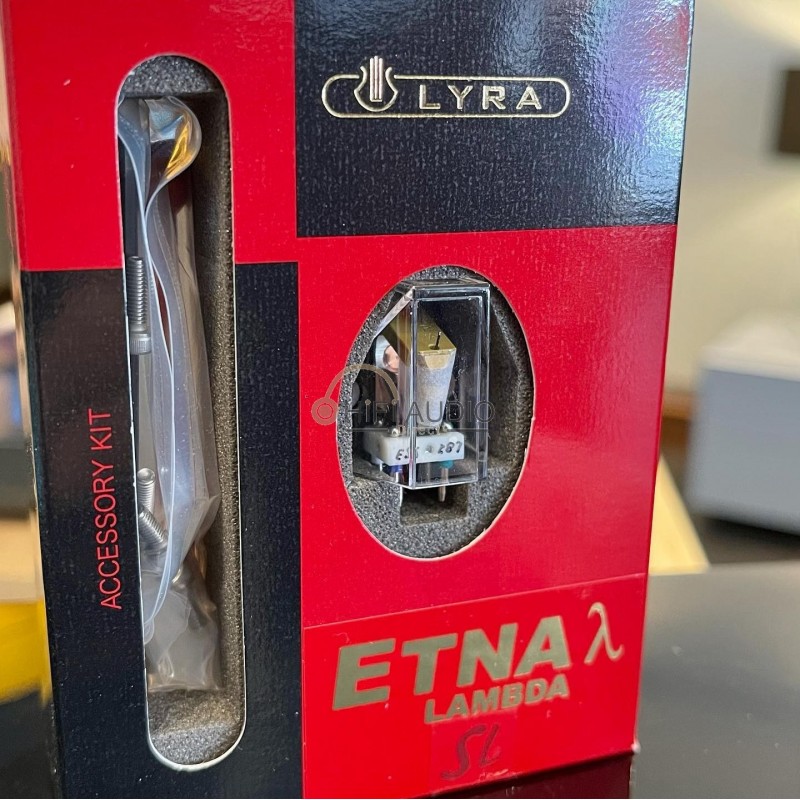


Brand New Lyra Etna Lambda SL MC Phono Cartridge with International Warranty
Lyra again turns the analog world on its ear with the introduction of the Etna λ Lambda SL phono cartridge. Sharing its name with Sicily’s majestic Mount Etna, Etna λ Lambda SL the cartridge is an impressive monument in its own right, one that melds tried and true Lyra design tenets with designer Jonathan Carr’s very latest thinking on phono cartridges.
Etna λ Lambda SL was designed with a strong emphasis on engineering efficiency, so that its performance would be as far beyond the sum of its parts as possible. For this reason, although it shares some of its design philosophy with Atlas λ Lambda SL, the concepts are executed rather differently.
Etna λ Lambda SL employs a solid titanium core structure machined with non-parallel surfaces to inhibit internal reflections whenever possible, but unlike Atlas (and Titan i before it), this is mated to a slightly undersized, asymmetric, mirror-black anodized duralumin outer body that locks over the core like a very tightly-fitting jigsaw puzzle. The core and body are augmented with bronze and stainless-steel resonance control rods, then pressure-fit together into a pre-stressed, solid, void-free structure which is comprised of multiple materials and complex internal shapes. The constrained-layer nature of this construction dramatically reduces the resonant signature of each material and creates a far more neutral-sounding body structure than otherwise possible, while the high body stiffness benefits transients, dynamics and resolution.

Brand New Lyra Etna Lambda SL MC Phono Cartridge with International Warranty